Fez
Fez Travel Guide
Of the four imperial Moroccan cities, Fez is both the oldest and the most impressive. Its old town, or medina, is ranked as a UNESCO World Heritage Site and houses the oldest university in the world. Within its myriad medieval streets, a wonderland of vibrant color, sound, and scent awaits.
A City of Old and New
Fez was founded in 789 by Idris, the Arab ruler responsible for founding the Idrisid dynasty. Since then, it has earned itself a reputation as an important center of trade and learning. It has served as Morocco's capital on several different occasions, and experienced its own Golden Age under the rule of the Marinids, the dynasty that presided over Fez during the 13th and 14th centuries. Many of the medina's most iconic monuments including its Islamic colleges, palaces, and mosques) date from this glorious period of the city's history.Today, the medina is known as Fez el-Bali, and its magic remains undimmed by the passage of time. Hire a guide to take you through its labyrinthine streets, or enjoy the sensation of getting lost on your own. You'll find market stalls and local artisans' workshops, ornate fountains, and local hammams. Outside the medina lies the newest part of Fez, referred to as Ville Nouvelle. Built by the French, it is another world entirely, comprised of wide boulevards, modern shops, and busy traffic (while the old town remains pedestrianized).
Key Attractions
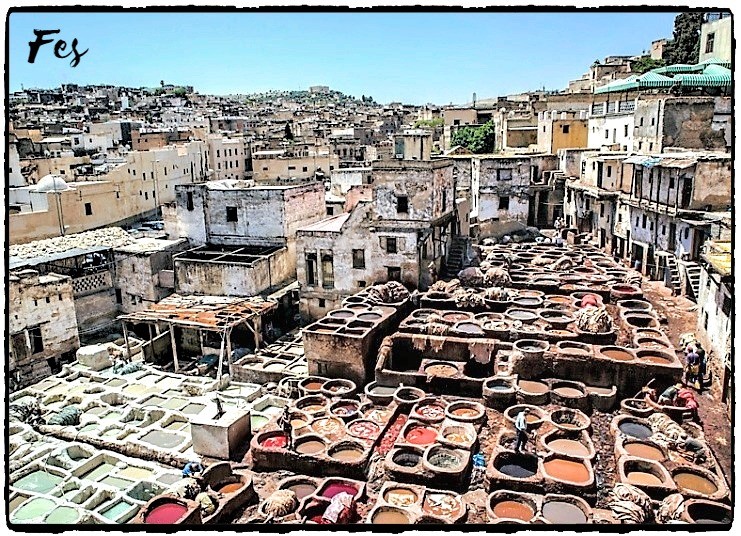
Take the mountain air in the Plaza Uta el Hamman. The N2 road from Tetouan leading to the town arrives just below the old walls. By climbing up through the marketplace you reach a gate called Bab el Ain, overhung by a wrought-iron lantern. This leads to the main square, the cobbled Plaza Uta el Hamman, shaded by trees, strung with lights and lined by bowed cafés, which is an excellent place to sit, appreciate the light and inhale the mountain air (not to be confused with the scent of kif drifting from the cafés’ upper storeys).• Chaouwara Tanneries—Fez is famous for its leather, and at traditional tanneries like Chaouwara, leather production methods have changed very little since medieval times. Here, skins are laid out to dry in the hot sun and vast vats are filled with dyes made from turmeric, poppy, mint, and indigo. Pigeon dung is used to soften the leather before it is dyed, and the stench of the tanneries is often overwhelming. However, the rainbow colors of the dye vats in the early morning make for excellent photos.
• Kairaouine Mosque—Tucked deep into the heart of the medina, the Kairaouine Mosque is the second-largest mosque in the country. It's also associated with the world's oldest continuously run university, the University of Al-Karaouine, whose origins date back to the mid-9th century. The library at Kairaouine Mosque is one of the oldest and most important in the world. Non-Muslims will have to content themselves with viewing the mosque from the outside, however, because they are not allowed to enter inside.
• Medersa Bou Inania—The Medersa Bou Inania is a historic Islamic college built during the rule of the Marinids. It is one of the finest extant examples of Marinid architecture in Morocco and is open to members of all faiths. Although the layout of the college is relatively simple, the adornments that cover almost every surface are not. Magnificent stucco work and intricate wood carving can be found throughout, while expensive marbles glisten in the courtyard. The Islamic zellij, or mosaics, are particularly impressive.